
What makes alpaca fiber so special?
Alpaca fiber has ranked as a luxury fiber for literally thousands of years. Alpacas were bred in Pre-Columbian South America for over 5,000 years and were used in these ancient cultures to make clothing for royalty.
Alpaca fiber possesses some unique characteristics. While it can be as soft as cashmere, it is naturally hypoallergenic, warm, moisture resistant while also moisture wicking, flame retardant, and durable.

While similar to sheep’s wool, mohair, and cashmere, alpaca fiber has unique properties that make it particularly desirable.
- At a microscopic level, the scale of the shaft of an alpaca fiber is at a better angle than the scale of the shaft of sheep’s wool and other types of wool, thus reducing the “prickle”. Uniformity in the micron size of individual fibers (usually between 15-36 microns depending upon the grade of the fiber) also contributes to the superior softness of alpaca fiber.
- Alpaca fiber is naturally flame retardant and meets the US Consumer Product Safety Commission’s strictest standards for safety and is classified as a Class 1 Fiber- the safest level of flame resistance for use in clothing or furniture.
- Alpaca is lanolin free. Not only is this significant for those with lanolin allergies, but as a lanolin free wool fiber, it permits processing without high temperatures and harsh chemicals necessary for sheep and other types of wool.
- Alpaca fiber possesses unique thermal properties- it is light weight, but extremely potent at insulating. Thus, making it both warm and breathable.
- Alpaca fiber is water resistant and yet wicks water away. It is easier to clean up spills on alpaca fiber clothing because they do not tend to absorb quickly as with other types of wool.
- Alpaca clothing is naturally wrinkle-resistant.
- Alpaca fiber is exceedingly durable. It possesses one of the highest resistance factors of all known natural fibers. For example, a human hair’s resilience is rated at 100; wool at 122.8, mohair at 136- while alpaca is rated at a whopping 358.5 (source: “What Makes Alpaca Fiber so Great”, by Meyla Bianco Johnston https://www.openherd.com/articles/1136/what-makes-alpaca-fiber-so-great%3F).
- Alpaca fiber comes in about 16 recognized beautiful, natural colors with exquisite sheen, brightness, or luster, and can be blended or dyed into an unlimited number of colors. (Chart courtesy of Alpaca Registry Inc.).
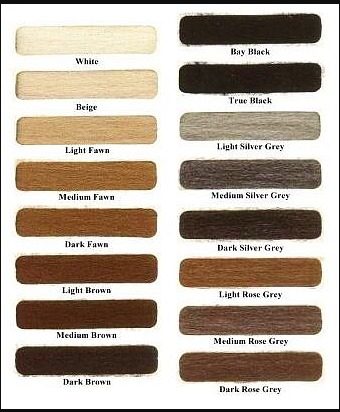
*** Information gleaned from the Alpaca Owner’s Association Website.
There are two types of alpacas- the soft, fluffy huacaya, whose fleece grows in crimpy bundles, and the silky suri, whose fiber grows in long locks. All the alpacas currently on the Urlakis Family Farm are huacaya.
At the time of shearing, the fleece from the alpacas is sorted into three categories: Firsts or Primary, Seconds, and Thirds. We sell all three grades of alpaca fiber.
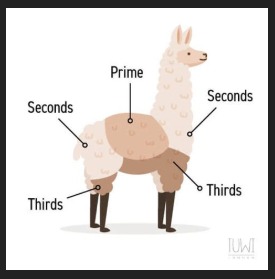
The Firsts, Primary, or Blanket is the most desirable of the fleece. It comes from the area of the animal where a horse blanket would fit. The staple length of the fiber is typically between 3 and 7 inches in this section. This fiber is best suited for high quality yarn for spinning, weaving, and clothing production.
Seconds come from the neck and upper leg regions. Seconds are similar to Prime or blanket, and can be very soft, but have a shorter staple length (2-5 inches) and have a somewhat coarser texture. These fibers can still be used for spinning, weaving, felting, rug making, dryer balls, and craft projects.
Thirds are the least desirable. These fibers come from the lower leg, lower chest, and belly. The staple length is about 2 inches, and this fiber is the coarsest of all. This fiber can be used in craft projects. We sell it in suet feeders for bird enthusiasts to supply nesting material for their feathered friends.
At the present time, the blanket or Prime fleeces that we have for sale are unskirted. That is, they have not been screened to remove stray pieces of vegetal matter- straw, grass, etc. I hope to be able to skirt all of the 2024 sheared fleeces soon and upload photos to this site.
8 oz bags of seconds or thirds ( as well as mixed bags of seconds and thirds) are available for crafting. These items are available via the Richfield Farmers Market.
 Urlakis Family Farm, LLC